Search a question on Google today, and there’s a good chance you’ll get your answer before you even scroll past the first few lines. That’s the experience I’ve had myself more than once — a quick search, a clear AI-generated summary, and no real reason to click through to a website. It’s convenient. But it also raises a real question about AI Overviews web traffic: if people are getting answers without clicking, what happens to the websites that used to receive that traffic?
A new academic study gives us one of the clearest answers yet — and it uses Wikipedia, one of the most-cited sources on the internet, as its test case.
The Study: What Researchers Actually Measured
The Study: What Researchers Actually Measured About AI Overviews and Web Traffic
AI Overviews and web traffic have become an important topic for publishers and website owners as Google’s AI-powered search feature changes how people discover information online. A University of Washington working paper, authored by Mehrzad Khosravi and Hema Yoganarasimhan, estimated the causal impact of Google’s AI Overviews on Wikipedia traffic.
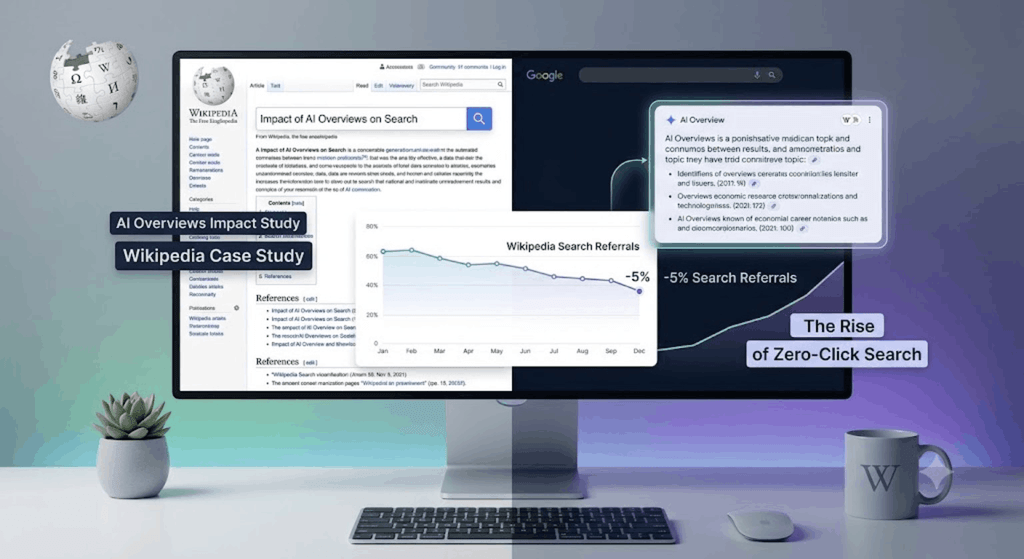
The study provides useful evidence for understanding the relationship between AI Overviews and web traffic, particularly for informational websites that depend heavily on search engines for visitors.The headline finding: default AI Overview availability reduced monthly external-search referrals to English Wikipedia by about 5.45% relative to German and 4.82% relative to French.
That’s a real, measurable dent — not a catastrophic collapse, but not nothing either, especially for a site that runs almost entirely on donations and volunteer contributions rather than ad revenue.
A Number That’s Already Shrunk Once
Interestingly, this isn’t even the researchers’ original estimate. The paper’s newer, smaller figure replaced a larger estimate the same authors had published earlier, and the revision itself became part of the story — a reminder that measuring AI’s impact on traffic is still a moving target, not a settled science.
Google, for its part, disputes whether this kind of combined referral metric can cleanly isolate its feature’s effect — a fair pushback, since traffic is shaped by dozens of forces at once.
AI Overviews and Web Traffic: What Wikipedia Reveals
Wikipedia provides a useful case study for understanding AI Overviews and web traffic because it is primarily a knowledge resource rather than an advertising-driven website. This makes its traffic patterns particularly useful for examining how AI-generated search summaries can affect visits to informational websites and whether users continue clicking through to the original sources.
Why Wikipedia Is a Useful Case Study
I think Wikipedia is actually one of the best places to study this effect, for a simple reason: it’s not trying to game search rankings, run ads aggressively, or chase clicks. It’s just a knowledge base. That makes it a cleaner signal for understanding AI Overviews and web traffic, especially when it comes to informational content that can often be answered directly by an AI summary.
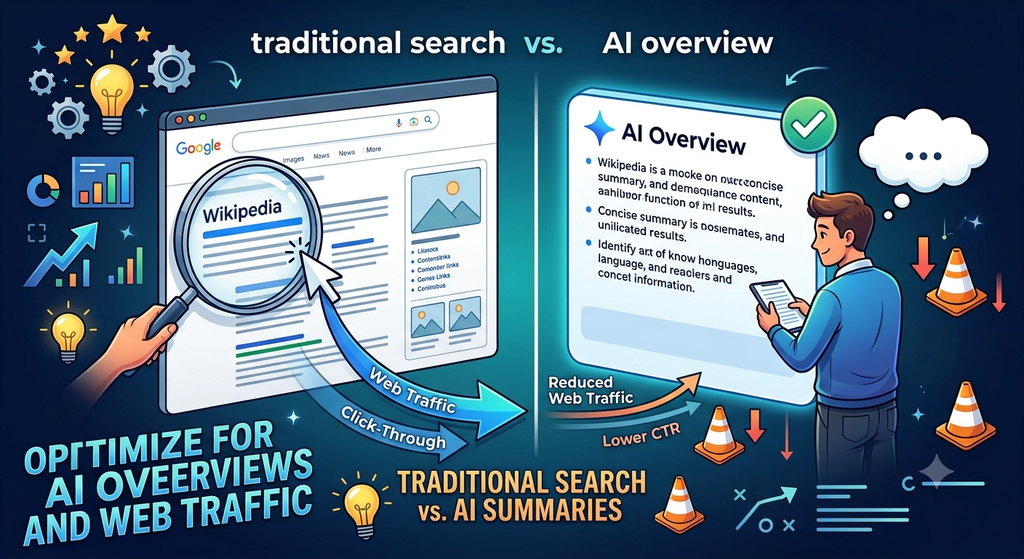
This connection between AI Overviews and web traffic is important because informational searches are increasingly being answered directly on the search results page. When users get enough information from an AI-generated summary, they may have less reason to visit the websites that originally published or collected that information.
This lines up with what I’ve noticed in my own searches. When I look up simple factual questions, the AI Overview often gives me enough to move on — and I explore fewer sites than I normally would. Multiply that behavior across millions of searches a day, and a few percentage points of lost referral traffic starts to make sense.
It’s Not Just AI Overviews
Wikipedia’s traffic story is more tangled than one single cause. Wikimedia has also had to improve its bot detection and reclassify traffic from March through August 2025, after a spike that looked like real human visits turned out to be driven largely by bots designed to bypass detection. That’s a separate issue from the AI Overviews effect, and the researchers are careful not to conflate the two.
Looking ahead, Wikimedia’s own planning documents suggest they don’t expect this to be temporary. The Foundation’s draft plan for the 2026-27 fiscal year highlights that decreasing pageviews and fewer referrals from Google, along with unprecedented bot traffic, are expected to continue rather than resolve quickly. This broader trend makes AI Overviews and web traffic an important issue for publishers and website owners to monitor as search behavior continues to change.
The Bigger Picture: Zero-Click Search Is Growing
Wikipedia’s ~5% dip is a useful data point, but it’s part of a much larger pattern across the web:
Metric
Finding
Organic CTR on AI Overview queries
Dropped from 1.76% to 0.61% (a 61% decline)
Searches ending without any click
Around 60%
Google referral traffic to publishers (YoY)
Down roughly 38%
AI search visits growth (YoY)
Up 42.8%
Brands cited in AI Overviews vs. uncited
~120% more organic clicks per impression
That last stat matters a lot. Being cited inside an AI Overview isn’t the same as being ignored by it — sites that earn a citation tend to hold onto traffic far better than sites that get summarized without a mention.
Is AI Overviews Traffic Loss Actually Balanced?
This is where I think the nuance really matters, and it’s a view backed by the data. AI Overviews clearly reduce clicks for simple, single-answer queries — the kind Wikipedia handles constantly. But the picture isn’t purely negative:
Citation-earning content holds up better. Comparison pages, deep guides, and original research tend to retain traffic even when AI Overviews appear.
AI-driven referral traffic is growing fast, even as traditional organic clicks shrink, meaning the channel is shifting rather than disappearing entirely.
Visibility inside an AI Overview can still build brand awareness, even without a click — something traditional CTR metrics don’t fully capture.
So the honest answer is: it depends heavily on the type of content and the type of query.
What This Means If You Run a Website
Based on where the data points, here’s what actually makes sense for publishers and bloggers right now:
Focus on content AI Overviews can’t fully replace. Original research, first-hand experience, and detailed analysis are much harder to compress into a two-line summary.
Aim to get cited, not just ranked. Structuring content so it’s easy for AI systems to quote and attribute can meaningfully offset lost clicks.
Don’t rely solely on simple, factual queries. These are exactly the searches most likely to end without a click.
Track referral sources, not just total traffic. Understanding how much of your traffic already comes from AI search tools helps you plan realistically.
Accept that some decline in simple-query traffic is now structural, not a short-term dip — and build a strategy around it rather than waiting for it to reverse.
FAQs
How much did AI Overviews reduce Wikipedia’s traffic? A University of Washington study estimated a reduction of roughly 5% in monthly external-search referrals to English Wikipedia, compared to non-exposed language editions.
Is this study peer-reviewed? No — it’s a working paper, most recently updated in September 2026, and hasn’t yet gone through peer review.
Does this mean AI Overviews are killing website traffic? Not entirely. While simple factual queries are seeing real click declines, sites that earn citations inside AI Overviews, or that produce original, hard-to-summarize content, tend to hold up better.
Conclusion
The Wikipedia study offers one of the clearest, most methodologically careful looks yet at how AI Overviews are reshaping web traffic — and the answer is nuanced. A roughly 5% decline in referrals isn’t catastrophic, but it’s a real signal that simple, answerable queries are increasingly staying inside Google’s own results page. The practical takeaway for anyone running a website: the fight isn’t really for clicks anymore — it’s for citations, depth, and the kind of original value that a two-line AI summary simply can’t replace.
As a freelance digital marketing consultant in Kochi, I help businesses build a stronger online presence through practical and result-focused digital marketing strategies. I offer services such as SEO, social media marketing, content marketing, keyword research, and website optimization to help businesses improve their online visibility and connect with the right audience. My approach focuses on understanding each business’s goals and creating customized strategies that support sustainable growth, better engagement, and increased website traffic.