Table of Contents
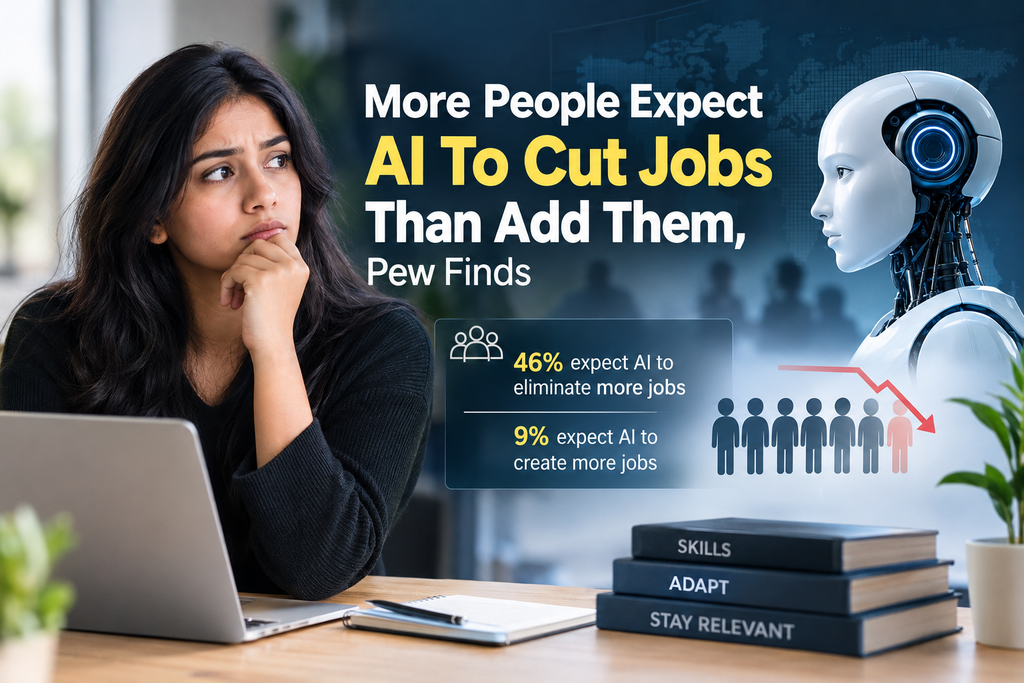
If you’ve had a conversation about AI at work recently, you’ve probably heard some version of this: “If AI can do this faster than me, what happens to my job?” That worry isn’t just anecdotal anymore — it’s now backed by hard numbers from one of the most respected research organizations in the world.
A new AI job losses survey from Pew Research Center confirms what a lot of people have quietly been feeling for a while: more people expect AI to shrink the job market than grow it. And the gap isn’t small.
I spend my time studying how AI is reshaping skills, hiring, and career paths, and I’ve watched this anxiety build in real time — in conversations with colleagues, clients, and people just trying to figure out where they stand. This article breaks down what Pew actually found, why the fear is justified (but not the whole story), and what you can actually do about it
What Pew’s AI Job Losses Survey Found
Pew Research Center’s new study looked at how people around the world view AI, including how opinions vary by age and across high- and middle-income countries. Across a 37-country median, 46% of people predict AI will eliminate more jobs than it creates, while just 9% said AI will fuel job creation. Pew Research CenterGizmodo
Pew surveyed 42,151 adults across 36 countries between February 8 and May 13, 2026, with additional U.S.-specific surveys conducted separately. Americans gave one of the strongest job-loss responses in the entire survey — 71% said AI would lead to fewer jobs in the U.S. over the next 20 years, with only 5% expecting more jobs. Search Engine JournalAll Blog Things
That U.S. number isn’t static, either. The share of Americans saying AI will lead to fewer jobs rose from 64% in August 2024 to 71% in June 2026. ThePrint8
Who’s Most Worried
The pessimism isn’t evenly spread. A few patterns stand out:
- Wealthy countries worry more. Pew identified a clear trend toward pessimism in countries with higher GDP, likely reflecting fears about automation of white-collar work and wage pressure. Gizmodo
- Younger workers are increasingly anxious. In several countries — including Canada, France, Singapore, Sweden, India, Indonesia, and Malaysia — adults aged 18 to 34 were more likely than those 50 and older to expect fewer jobs. All Blog Things
- One country bucked the trend. Nigeria was the only nation where more people expected AI to create jobs than eliminate them (27% vs. 26%). Gizmodo
- Country Snapshot
Country
% Expecting Fewer Jobs
Australia
76%
South Korea
76%
United States
71%
Nigeria
26% (more expected job growth)
Is This Fear Actually Playing Out? - This is where my own observations line up closely with what the AI job losses survey data suggests. In the work I’ve done tracking AI’s real-world impact, the roles feeling the earliest pressure are the ones built around repeatable, well-defined tasks — content writing, customer support, and data entry are the clearest examples. AI tools are now handling first drafts, ticket triage, and data cleanup fast enough that some roles are shrinking or shifting rather than disappearing outright.
- The findings from the AI job losses survey also highlight an important distinction between job losses and changes in hiring. The ground-level picture is more nuanced than the headlines suggest. A Stanford Digital Economy Lab study using payroll data through June 2026 found that employment among workers aged 22 to 25 in highly AI-exposed occupations was about 19% below what researchers would have expected without AI, with the gap driven mainly by reduced hiring rather than layoffs. In other words, it’s not that people are getting fired en masse — it’s that fewer new roles are opening up for entry-level talent in exposed fields.
- At the same time, the AI job losses survey does not mean that every industry or employer expects AI to reduce employment. Not everyone agrees on how significant the threat will be. A 2026 KPMG CEO Outlook survey found only 9% of large-company CEOs planned to cut jobs because of AI, while 55% expected to increase hiring as a direct result of it. That’s a meaningful counterpoint: the expectations of business leaders involved in hiring decisions are considerably different from the concerns reflected in the AI job losses survey.
The Biggest Misconception About AI and Jobs
Here’s a myth worth clearing up directly: AI is not going to replace every job.
What’s actually happening is more selective. AI is best at repeatable, rules-based tasks — not judgment calls, relationship-building, or creative problem-solving. People who learn to work with AI, rather than compete against it, are generally the ones adapting well. I’d put the real state of things somewhere in the middle: AI will change a meaningful share of jobs, but it will also create new kinds of work — often roles that didn’t exist five years ago, built around managing, prompting, and auditing AI systems.
What You Can Actually Do About It
If you’re feeling the same unease the Pew numbers point to, here’s practical advice based on what’s actually working for people adapting well:
Learn to use AI as a tool, not a threat. Getting hands-on with AI tools relevant to your field is the single most useful thing you can do right now.
Double down on human skills. Communication, creativity, and problem-solving are hard for AI to fully replicate — and they’re becoming more valuable, not less.
Watch which tasks are becoming automatable in your role, and shift your focus toward the parts of your job that require judgment, context, or relationship-building.
Stay current on how your industry specifically is being affected — the risk level varies enormously by role and sector.
Treat this as an ongoing skill-building process, not a one-time fix. The tools are changing fast, and staying static is the real risk.
FAQs
Is AI really going to cause mass job losses?
The data shows widespread expectation of job loss, but real-world evidence so far points to more selective disruption — automation of specific repeatable tasks and reduced hiring in some entry-level, AI-exposed roles, rather than sweeping layoffs.
Which jobs are most at risk right now?
Roles built around repeatable, well-defined tasks — like basic content writing, customer support, and data entry — are seeing the earliest and clearest AI impact.
Will AI create new jobs too?
Yes. While public sentiment currently leans pessimistic, new roles are emerging around managing, prompting, and overseeing AI systems — categories that barely existed a few years ago.
Conclusion
Pew’s findings confirm that AI job loss fears are widespread and growing, especially in wealthier countries and among younger workers. But fear isn’t the same as destiny. The people navigating this shift best aren’t the ones avoiding AI — they’re the ones learning to work alongside it while sharpening the skills AI can’t easily replace. If there’s one actionable takeaway from this AI and job displacement trend, it’s this: start building AI fluency now, before it becomes a requirement rather than an advantage.
As a Freelance Digital Marketing Consultant in Kochi, I help businesses build a strong online presence through effective digital marketing strategies. I focus on SEO, social media marketing, content marketing, and website optimization to improve online visibility and reach the right audience. My goal is to understand each business’s needs and create practical, result-oriented strategies that support long-term growth. If you are looking for a Freelance Digital Marketing Consultant in Kochi, I can help you develop a stronger digital presence and connect with your target customers online.