Table of Contents
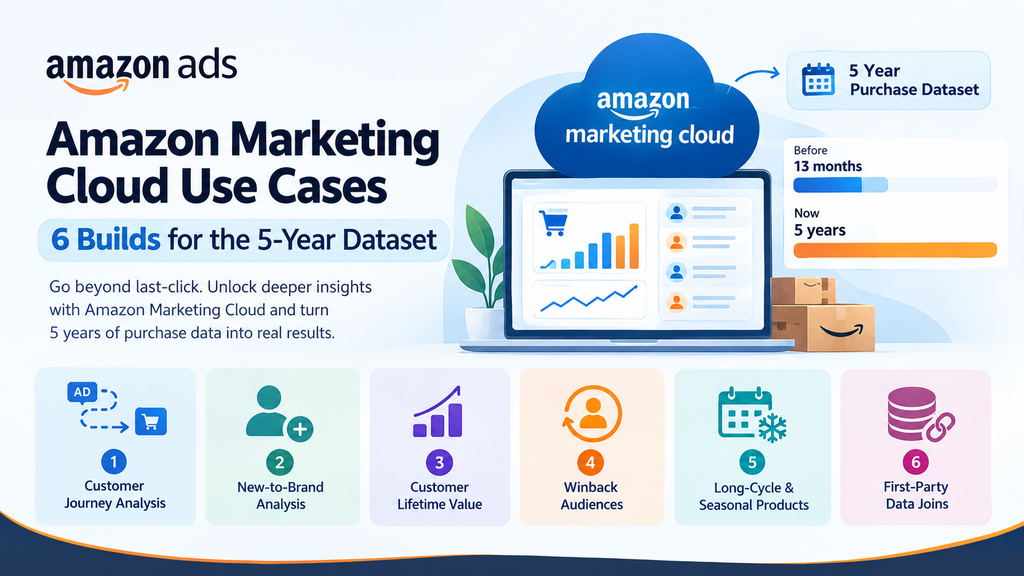
Amazon Marketing Cloud use cases just got a lot more interesting. Amazon Ads announced at CES 2025 that brands can query up to five years of store purchase signals in AMC, up from 13 months. That gap mattered. Thirteen months works for a monthly consumable. It fails for a laptop, a mattress, or a lawn mower.
So, which Amazon Marketing Cloud use cases can benefit most from five years of purchase data?
Here are six ideas, starting with the one I’d tackle first.
What Is the Amazon Marketing Cloud 5-Year Dataset?
Amazon Marketing Cloud (AMC) is a secure, privacy-safe clean room that gives advertisers planning and measurement tools. Think of it as a place where you can ask deeper questions than a last-click report allows.
The five-year window comes through the Amazon Retail Purchases dataset. It extends the lookback on Amazon Store purchase signals from 13 months to five years, and it targets durable, replenishable, and seasonal products.
Two details are worth knowing before you plan anything:
- It has a price. There’s a 60-day free trial, then it costs $500 per month. It is free for audience creation.
- Ad data has its own window. Amazon extended the ad traffic lookback from 13 to 25 months in November 2025. So the five years covers purchases, not ad exposure.
6 Amazon Marketing Cloud Use Cases Worth Building Now
These Amazon Marketing Cloud use cases are especially useful for brands with repeat purchases, long buying cycles, seasonal demand, or valuable customer relationships.
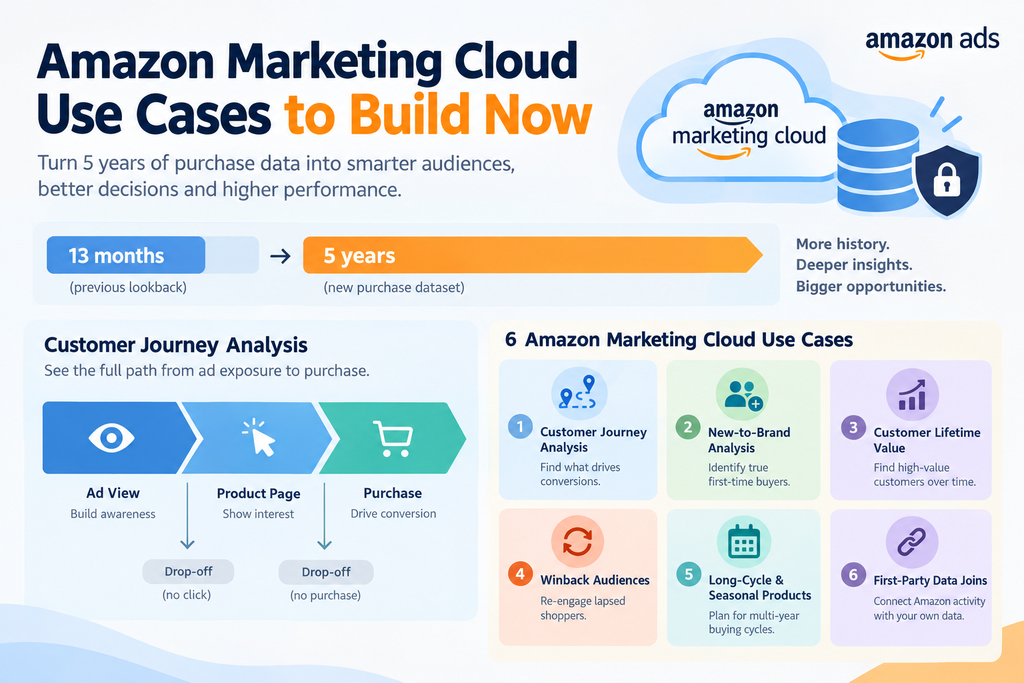
1. Customer Journey Analysis
This is where I’d start. Journey analysis shows how people move from ad exposure to purchase. It also shows which touchpoints matter most and where customers drop off.
In one campaign I looked at, shoppers saw an ad, visited the product page, and bought later. Repeated exposure helped move interested shoppers closer to conversion. A last-click report would never show that pattern.
Tip: Build the path first, then check the numbers. Because ad exposure data covers 25 months, keep journey questions inside that window
2. More Accurate New-to-Brand Analysis
New-to-brand (NTB) tracks first-time buyers. With only 13 months of history, a returning customer can look brand new. Five years fixes much of that.
Some brands find that the full five years is too long for NTB, and AMC lets you customize the lookback. A snack brand and a laptop brand should not use the same window. Search Engine Journal
3. Customer Lifetime Value
Longer history makes lifetime value (LTV) more trustworthy. Quartile’s example compares a $40 supplement bought every three months for five years with a $100 bundle bought yearly for two years. The first customer is worth more, even though each order is smaller.
Once you can see that difference, you can bid smarter for the customers who actually last.
4. Winback Audiences
Lapsed shoppers are often cheaper to reach than strangers. Five years of purchase history helps brands win back shoppers lost more than a year ago, with custom lookback windows and minimum LTV thresholds.
Start with a small audience of past high-value buyers. Then compare their results against a cold audience.
5. Long-Cycle and Seasonal Products
Products like laptops may be bought every three to five years, and categories like allergy medicine and lawn and garden are seasonal. Thirteen months barely covers one cycle for these brands. Five years shows several.
6. First-Party Data Joins
This one is underused. Brands can upload hashed first-party shopper data, such as a direct-to-consumer purchase history or an email list, and join it with AMC datasets using privacy-safe IDs. You can then see how Amazon activity affects your own site sales, and the reverse.
Quick Comparison
| Use case | Question it answers | Best for |
| Customer journey analysis | Which touchpoints lead to purchase? | Any advertiser |
| New-to-brand analysis | Who is truly a new customer? | Brands with longer buying cycles |
| Lifetime value | Which customers are worth more over time? | Repeat-purchase brands |
| Winback audiences | Who stopped buying, and why? | Brands with a lapsed base |
| Long-cycle and seasonal | What happens between purchases? | Durables, seasonal goods |
| First-party joins | How do Amazon and my site interact? | Brands with strong DTC data |
Common Mistakes With AMC Data
I see two mistakes again and again.
Chasing single metrics. Marketers fixate on one number, like conversions, and miss the full customer journey. The metric is a symptom. The journey is the story.
Trusting messy data. Clean and interpret your data before making campaign calls. A wrong filter can turn a useful insight into an expensive mistake.
A Simple Way to Get Started
- Write one business question. For example: “Are we overpaying for customers who would have bought anyway?”
- Pick the matching dataset and window. Purchases can use five years. Ad exposure uses 25 months.
- Check your data. Confirm filters, date ranges, and product scope.
- Run a small query. Amazon also introduced an AI-powered SQL query builder, so you don’t need deep data science skills.
- Act on one insight. Change one bid, audience, or budget. Then measure again.
Limitations to Keep in Mind
This isn’t a magic switch. The five-year data costs extra after the trial. It covers Amazon store purchases only. Results also vary by category, product price, and buying cycle. Small brands with thin data may see noisy results, so test before you commit budget.
FAQs
What is Amazon Marketing Cloud?
It’s a privacy-safe clean room that lets advertisers analyze Amazon advertising and purchase signals beyond last-click reporting.
How far back can AMC look?
Up to five years for retail purchase signals, and 25 months for ad traffic.
Does the five-year dataset cost extra?
Yes, after a 60-day free trial. It’s free for audience creation.
Conclusion
The best Amazon Marketing Cloud use cases start with a clear business question, not a pile of data. Begin with customer journey analysis, then layer on NTB, LTV, and winback as your confidence grows. Focus on insights you can act on, not just more metrics to track.
A Freelance Digital Marketing Consultant in Kochi helps businesses build a strong online presence and reach the right audience through effective digital strategies. From SEO and social media marketing to content planning and website optimization, a freelance consultant can create practical strategies based on a business’s goals and target customers. For local businesses in Kochi, digital marketing can improve online visibility, attract potential customers, and support long-term growth. Working with a freelance digital marketing consultant also gives businesses flexible, personalized support without the need for a large in-house marketing team.https://akshayasatheesan.com/